BELL UH-1 HUEY IROQUOIS


The Bell UH-1 Iroquois (nicknamed "Huey") is a utility military helicopter powered by a single turboshaft engine, with two-bladed main and tail rotors. The first member of the prolific Huey family, it was developed by Bell Helicopter to meet a 1952 US Army requirement for a medical evacuation and utility helicopter, and first flew in 1956. The UH-1 was the first turbine-powered helicopter produced for the United States military, and more than 16,000 have been built since 1960.[1]
The Iroquois was originally designated HU-1, hence the Huey nickname, which has remained in common use, despite the official redesignation to UH-1 in 1962.[2] The UH-1 first saw service in combat operations during the Vietnam War, with around 7,000 helicopters deployed. The Bell 204 and 205 are Iroquois versions developed for the civil market.
Development[edit]

Bell XH-40, a prototype of the UH-1
Main article: Bell UH-1 Iroquois variants
In 1952, the U.S. Army identified a requirement for a new helicopter to serve as medical evacuation (MEDEVAC), instrument trainer, and general utility aircraft. The Army determined that current helicopters were too large, underpowered, or too complex to maintain easily. In November 1953, revised military requirements were submitted to the Department of the Army.[3] Twenty companies submitted designs in their bid for the contract, including Bell Helicopter with the Model 204 and Kaman Aircraft with a turbine-powered version of the H-43. On 23 February 1955, the Army announced its decision, selecting Bell to build three copies of the Model 204 for evaluation with the designation XH-40.[4]
Model 204[edit]
Main article: Bell 204/205
Powered by a prototype Lycoming YT53-L-1 (LTC1B-1) engine producing 700 shp (520 kW), the XH-40 first flew on 20 October 1956[5] at Fort Worth, Texas, with Bell's chief test pilot, Floyd Carlson, at the controls. Two more prototypes were built in 1957, and the Army had previously ordered six YH-40 service test aircraft, even before the first prototype had flown.[3][6] In March 1960, the Army awarded Bell a production contract for 100 aircraft, which was designated "HU-1A" and officially named Iroquois after the Native American nations.[7]
The helicopter quickly developed a nickname derived from its HU-1 designation, which came to be pronounced as "Huey". The reference became so popular that Bell began casting the name on the helicopter's anti-torque pedals.[2] The official U.S. Army name was almost never used in practice.[8] After September 1962, the designation for all models was changed to UH-1 under a unified Department of Defense (DOD) designation system, but the nickname remained.
While glowing in praise for the helicopter's advances over piston-engined helicopters, the Army reports from the service tests of the YH-40 found it to be underpowered with the production T53-L-1A powerplant producing a maximum continuous 770 shaft horsepower (570 kilowatts).[N 1] The Army indicated the need for improved follow-on models even as the first UH-1As were being delivered. In response, Bell proposed the UH-1B, equipped with the Lycoming T53-L-5 engine producing 960 shp (720 kW) and a longer cabin that could accommodate either seven passengers or four stretchers and a medical attendant. Army testing of the UH-1B started in November 1960, with the first production aircraft delivered in March 1961.[3]
Bell commenced development of the UH-1C in 1960 in order to correct aerodynamic deficiencies of the armed UH-1B. Bell fitted the UH-1C with a 1,100 shp (820 kW) T53-L-11 engine to provide the power needed to lift all weapons systems in use or under development. The Army eventually refitted all UH-1B aircraft with the same engine. A new rotor system was developed for the UH-1C to allow higher air speeds and reduce the incidence of retreating blade stall during diving engagements. The improved rotor resulted in better maneuverability and a slight speed increase.[6] The increased power and a larger diameter rotor required Bell's engineers to design a new tail boom for the UH-1C. The longer tail boom incorporated a wider chord vertical fin on the tail rotor pylon and larger synchronized elevators.
Bell also introduced a dual hydraulic control system for redundancy as well as an improved inlet filter system for the dusty conditions found in southeast Asia. The UH-1C fuel capacity was increased to 242 US gallons (920 liters), and gross weight was raised to 9,500 lb (4,309 kg), giving a nominal useful load of 4,673 lb (2,120 kg). UH-1C production started in June 1966 with a total of 766 aircraft produced, including five for the Royal Australian Navy and five for Norway.
Model 205[edit]
Main article: Bell 204/205
_%22N205SD%22.jpg)
Ventura County Sheriff's Department Air Unit Fire Support Bell HH-1H
While earlier "short-body" Hueys were a success, the Army wanted a version that could carry more troops. Bell's solution was to stretch the HU-1B fuselage by 41 in (104 cm) and use the extra space to fit four seats next to the transmission, facing out. Seating capacity increased to 15, including crew.[9] The enlarged cabin could also accommodate six stretchers and a medic, two more than the earlier models.[9] In place of the earlier model's sliding side doors with a single window, larger doors were fitted which had two windows, plus a small hinged panel with an optional window, providing enhanced access to the cabin. The doors and hinged panels were quickly removable, allowing the Huey to be flown in a "doors off" configuration.
The Model 205 prototype flew on 16 August 1961.[10][11] Seven pre-production/prototype aircraft had been delivered for testing at Edwards AFB starting in March 1961. The 205 was initially equipped with a 44-foot (13.4 m) main rotor and a Lycoming T53-L-9 engine with 1,100 shp (820 kW). The rotor was lengthened to 48 feet (14.6 m) with a chord of 21 in (53 cm). The tailboom was also lengthened, in order to accommodate the longer rotor blades. Altogether, the modifications resulted in a gross weight capacity of 9,500 lb (4,309 kg). The Army ordered production of the 205 in 1963, produced with a T53-L-11 engine for its multi-fuel capability.[N 2][12] The prototypes were designated as YUH-1D and the production aircraft was designated as the UH-1D.
In 1966, Bell installed the 1,400 shp (1,000 kW) Lycoming T53-L-13 engine to provide more power for the aircraft. The pitot tube was relocated from the nose to the roof of the cockpit, to prevent damage
CARACTERISTICI GENERALE
VARSTA 6
NUMAR PIESE 656
NUMAR FIGURINE 2
GRAD DIFICULTATE 5
BRAND COBI
DIMENSIUNI
LUNGIME 39 CM
LATIME 9 CM
INALTIME 13.5 CM
DIMENSIUNI CUTIE 45 CM X 6 CM X 30.5 CM
SCALA 1:32
PRODUSE NOI DIN CATEGORIE


TOP VANZARI
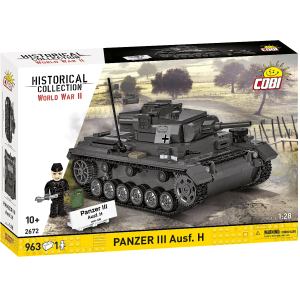
PANZER III AUSF.H
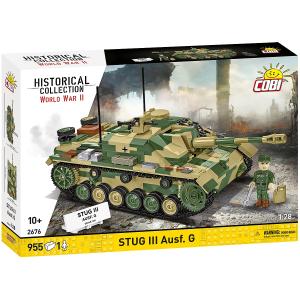
STUG III AUSF. G
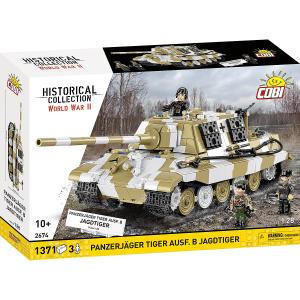
PANZERJäGER TIGER AUSF.B JAGDTIGER

FLAKPANZER IV WIRBELWIND - EXECUTIVE EDITION
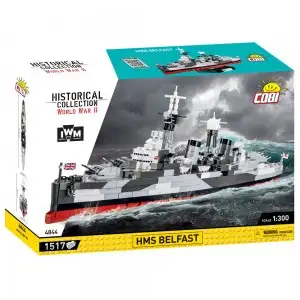
HMS BELFAST IWM

VOLKSWAGEN GOLF 1974-1983

PANZER V PANTHER AUSF. G PUDEL

PANZERKAMPFWAGEN II AUSF. F

PZKPFW IV AUSF. G
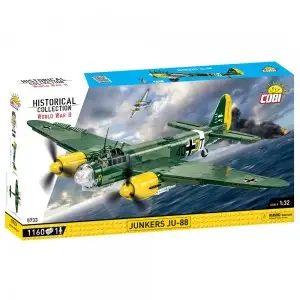
JUNKERS JU-88
SIKORSKY UH-60 BLACK HAWK


PANZER VI AUSF. B KONIGSTIGER

SHERMAN M4A2E8 76 W FURY